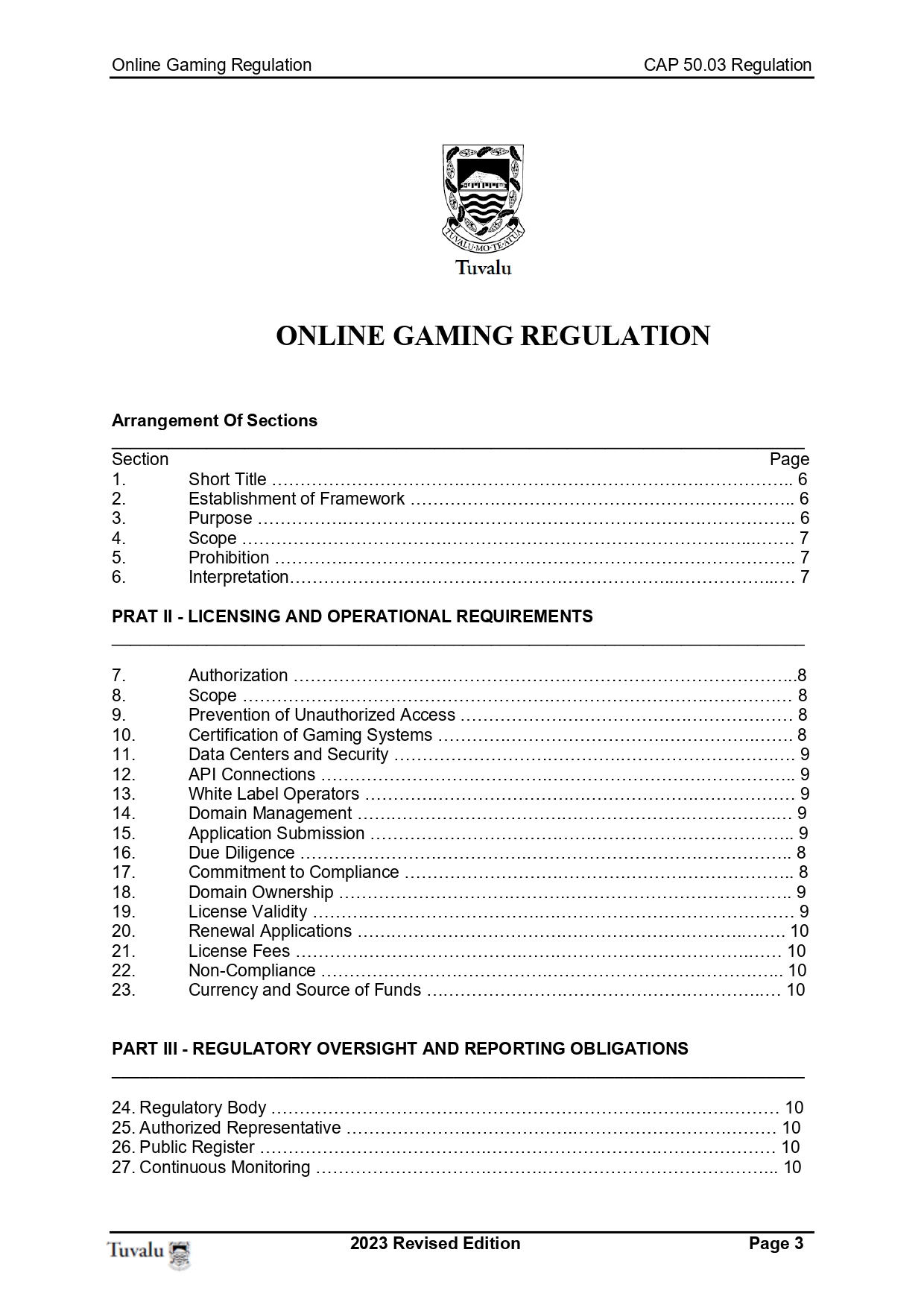
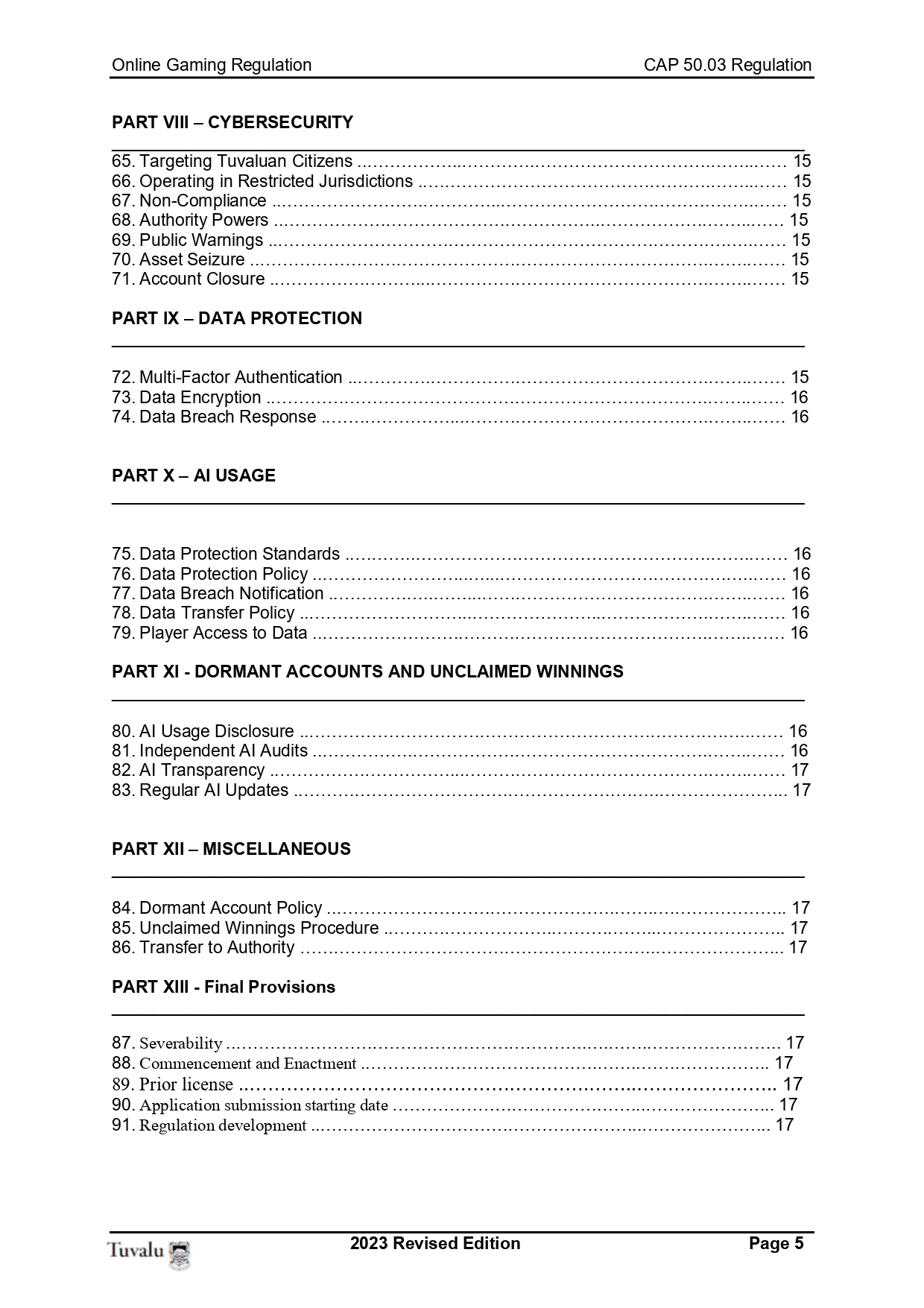

Arrangement Of Sections
PRAT II – LICENSING AND OPERATIONAL REQUIREMENTS
PART III – REGULATORY OVERSIGHT AND REPORTING OBLIGATIONS
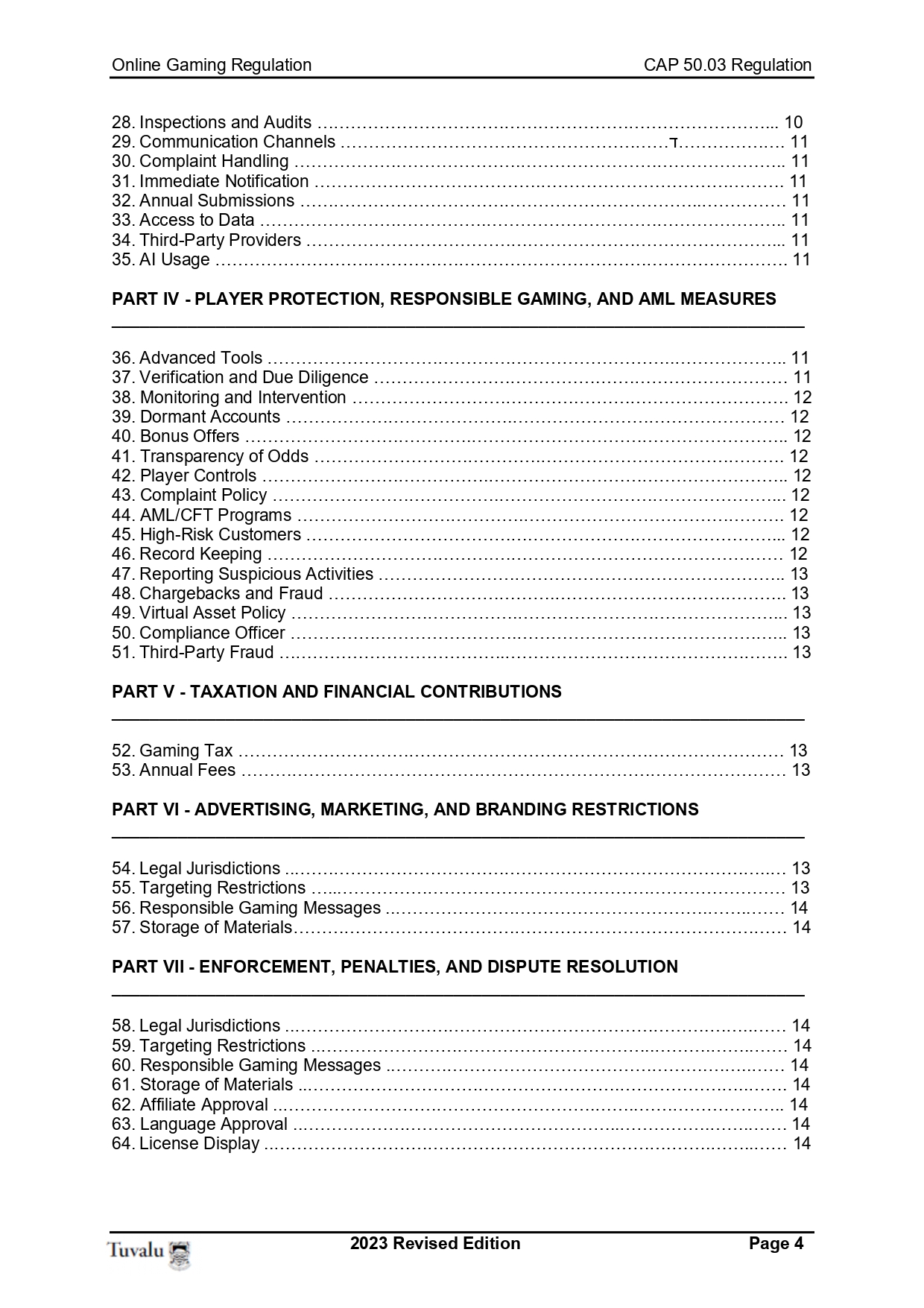
PART IV – PLAYER PROTECTION, RESPONSIBLE GAMING, AND AML MEASURES
PART V – TAXATION AND FINANCIAL CONTRIBUTIONS
PART VI – ADVERTISING, MARKETING, AND BRANDING RESTRICTIONS
PART VII – ENFORCEMENT, PENALTIES, AND DISPUTE RESOLUTION
PART XI – DORMANT ACCOUNTS AND UNCLAIMED WINNINGS
PART XII – MISCELLANEOUS
PART XIII – Final Provisions
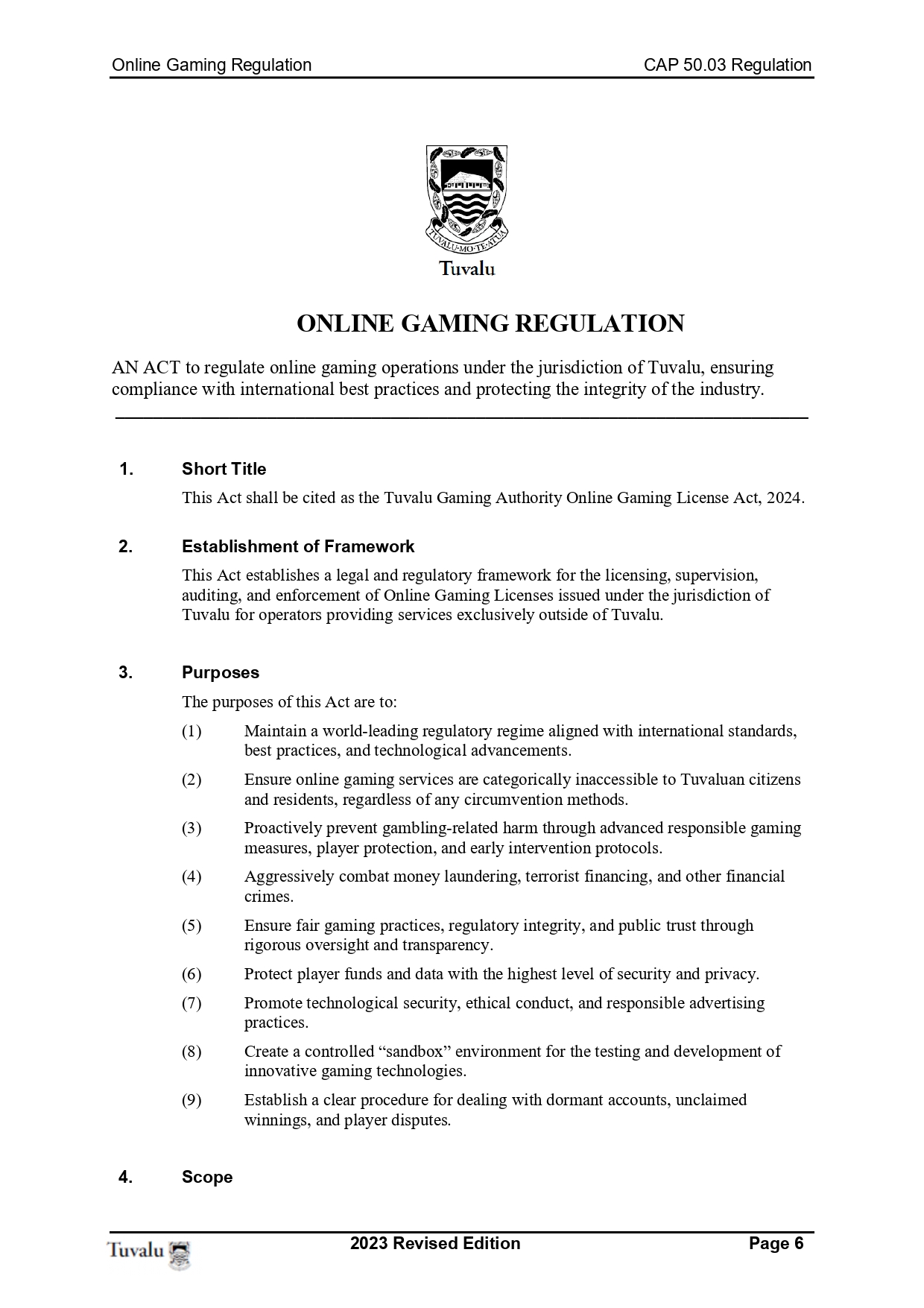
AN ACT to regulate online gaming operations under the jurisdiction of Tuvalu, ensuring compliance with international best practices and protecting the integrity of the industry.
This Act shall be cited as the Tuvalu Gaming Authority Online Gaming License Act, 2024.
This Act establishes a legal and regulatory framework for the licensing, supervision, auditing, and enforcement of Online Gaming Licenses issued under the jurisdiction of Tuvalu for operators providing services exclusively outside of Tuvalu.
The purposes of this Act are to:
Maintain a world-leading regulatory regime aligned with international standards, best practices, and technological advancements.
Ensure online gaming services are categorically inaccessible to Tuvaluan citizens and residents, regardless of any circumvention methods.
Proactively prevent gambling-related harm through advanced responsible gaming measures, player protection, and early intervention protocols.
Aggressively combat money laundering, terrorist financing, and other financial
Ensure fair gaming practices, regulatory integrity, and public trust through rigorous oversight and transparency.
Protect player funds and data with the highest level of security and
Promote technological security, ethical conduct, and responsible advertising
Create a controlled “sandbox” environment for the testing and development of innovative gaming technologies.
Establish a clear procedure for dealing with dormant accounts, unclaimed winnings, and player disputes.
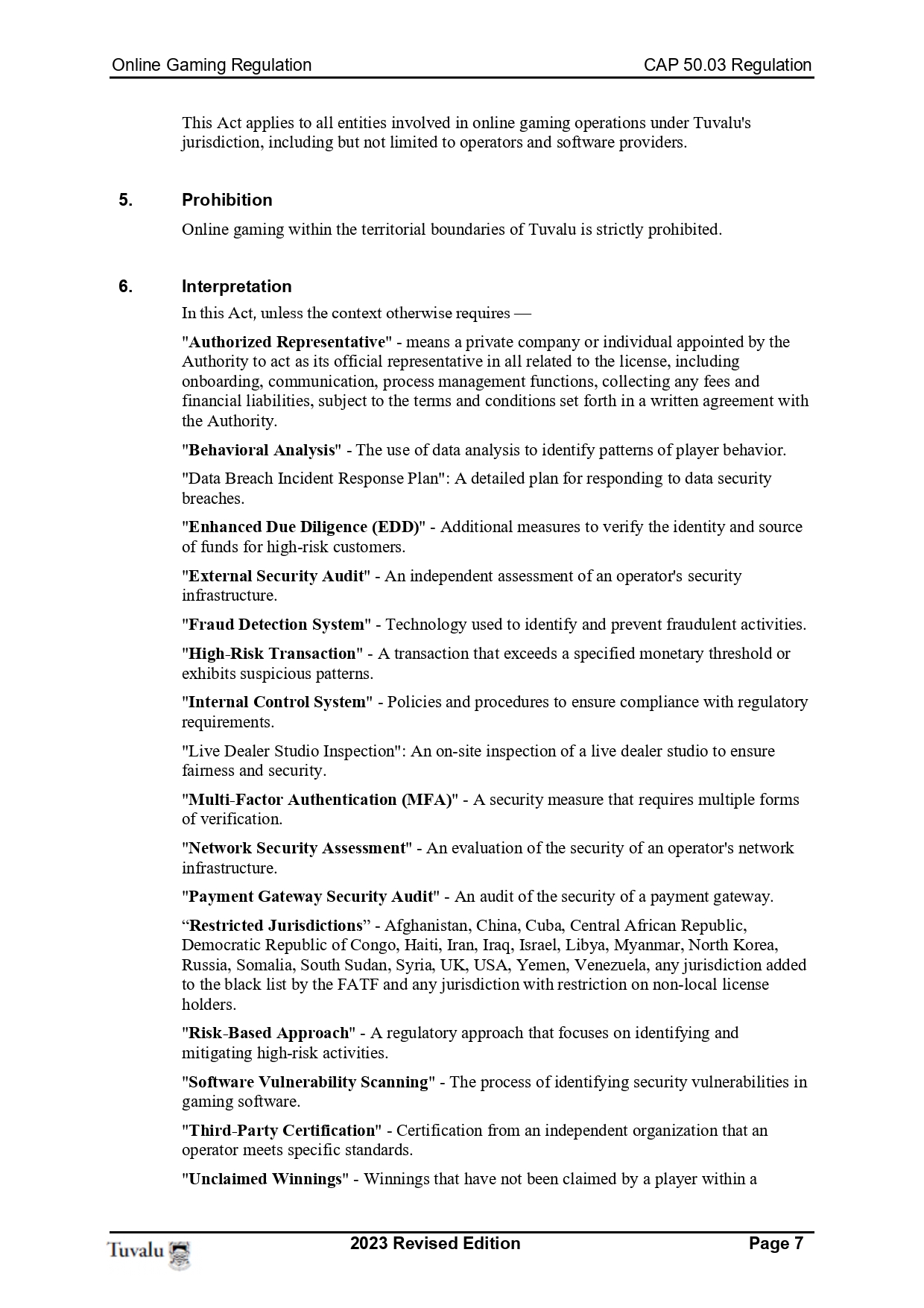
This Act applies to all entities involved in online gaming operations under Tuvalu’s jurisdiction, including but not limited to operators and software providers.
Online gaming within the territorial boundaries of Tuvalu is strictly prohibited.
In this Act, unless the context otherwise requires
“Authorized Representative” – means a private company or individual appointed by the Authority to act as its official representative in all related to the license, including onboarding, communication, process management functions, collecting any fees and financial liabilities, subject to the terms and conditions set forth in a written agreement with the Authority.
“Behavioral Analysis” – The use of data analysis to identify patterns of player behavior.
“Data Breach Incident Response Plan”: A detailed plan for responding to data security breaches.
“Enhanced Due Diligence (EDD)” – Additional measures to verify the identity and source of funds for high-risk customers.
“External Security Audit” – An independent assessment of an operator’s security infrastructure.
“Fraud Detection System” – Technology used to identify and prevent fraudulent activities.
“High-Risk Transaction” – A transaction that exceeds a specified monetary threshold or exhibits suspicious patterns.
“Internal Control System” – Policies and procedures to ensure compliance with regulatory requirements.
“Live Dealer Studio Inspection”: An on-site inspection of a live dealer studio to ensure fairness and security.
“Multi-Factor Authentication (MFA)” – A security measure that requires multiple forms of verification.
“Network Security Assessment” – An evaluation of the security of an operator’s network infrastructure.
“Payment Gateway Security Audit” – An audit of the security of a payment gateway.
“Restricted Jurisdictions” – Afghanistan, China, Cuba, Central African Republic, Democratic Republic of Congo, Haiti, Iran, Iraq, Israel, Libya, Myanmar, North Korea, Russia, Somalia, South Sudan, Syria, UK, USA, Yemen, Venezuela, any jurisdiction added to the black list by the FATF and any jurisdiction with restriction on non-local license holders.
“Risk-Based Approach” – A regulatory approach that focuses on identifying and mitigating high-risk activities.
“Software Vulnerability Scanning” – The process of identifying security vulnerabilities in gaming software.
“Third-Party Certification” – Certification from an independent organization that an operator meets specific standards.
“Unclaimed Winnings” – Winnings that have not been claimed by a player within a specified period.
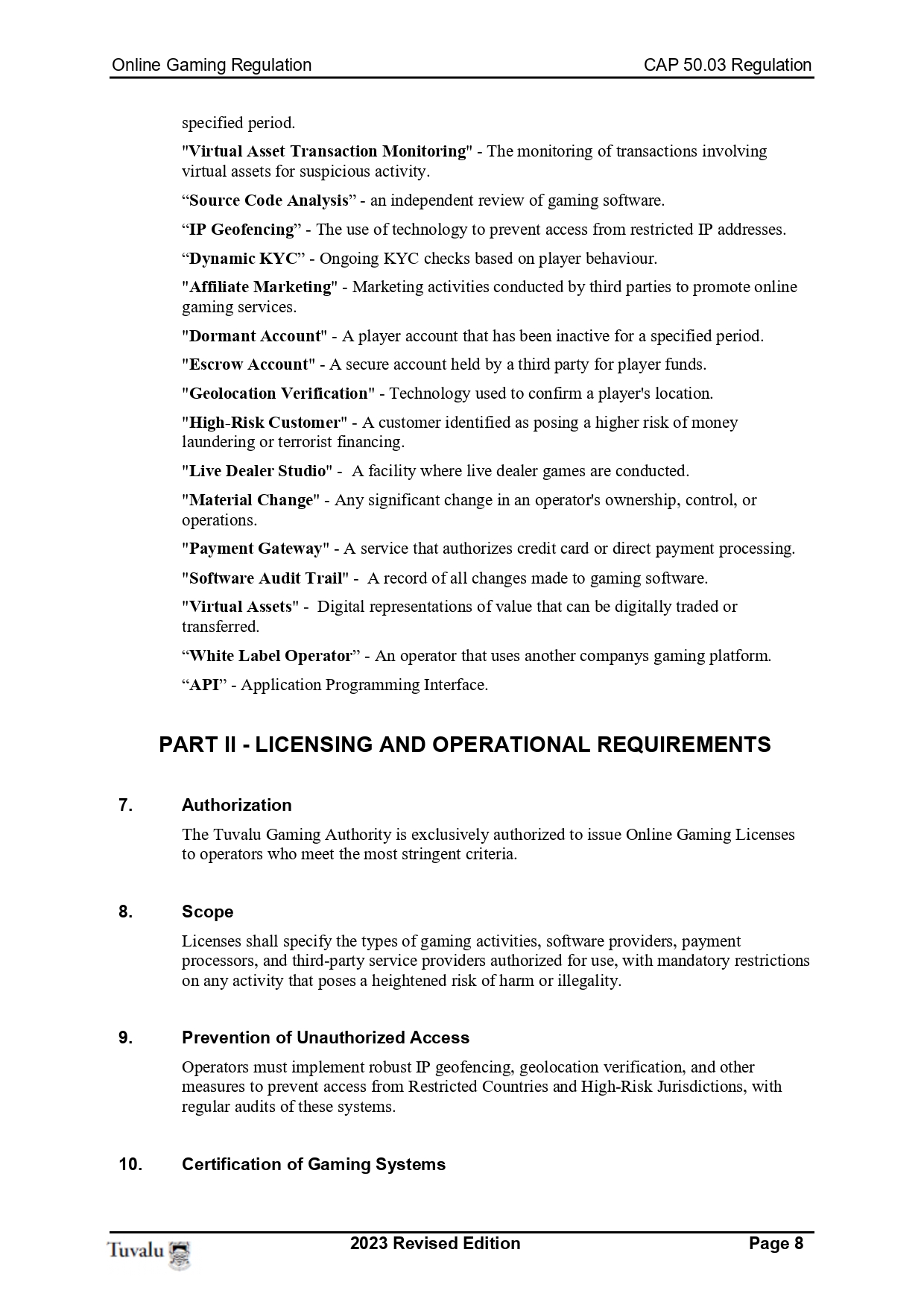
“Virtual Asset Transaction Monitoring” – The monitoring of transactions involving virtual assets for suspicious activity.
“Source Code Analysis” – an independent review of gaming software.
“IP Geofencing” – The use of technology to prevent access from restricted IP addresses.
“Dynamic KYC” – Ongoing KYC checks based on player behaviour.
“Affiliate Marketing” – Marketing activities conducted by third parties to promote online gaming services.
“Dormant Account” – A player account that has been inactive for a specified period.
“Escrow Account” – A secure account held by a third party for player funds.
“Geolocation Verification” – Technology used to confirm a player’s location.
“High-Risk Customer” – A customer identified as posing a higher risk of money laundering or terrorist financing.
“Live Dealer Studio” – A facility where live dealer games are conducted.
“Material Change” – Any significant change in an operator’s ownership, control, or operations.
“Payment Gateway” – A service that authorizes credit card or direct payment processing.
“Software Audit Trail” – A record of all changes made to gaming software.
“Virtual Assets” – Digital representations of value that can be digitally traded or transferred.
“White Label Operator” – An operator that uses another companys gaming platform.
“API” – Application Programming Interface.
The Tuvalu Gaming Authority is exclusively authorized to issue Online Gaming Licenses to operators who meet the most stringent criteria.
Licenses shall specify the types of gaming activities, software providers, payment processors, and third-party service providers authorized for use, with mandatory restrictions on any activity that poses a heightened risk of harm or illegality.
Operators must implement robust IP geofencing, geolocation verification, and other measures to prevent access from Restricted Countries and High-Risk Jurisdictions, with regular audits of these systems.
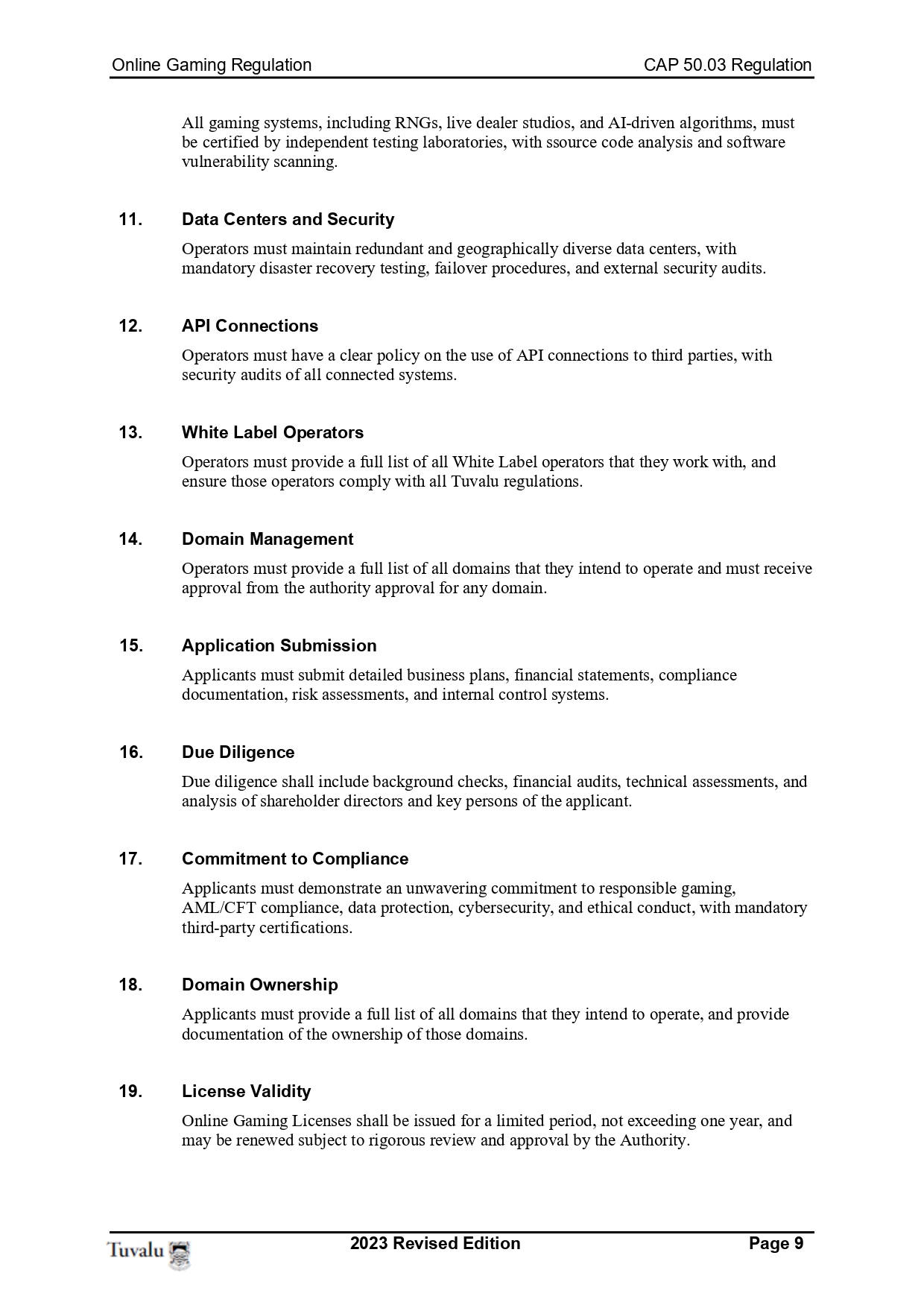
All gaming systems, including RNGs, live dealer studios, and AI-driven algorithms, must be certified by independent testing laboratories, with ssource code analysis and software vulnerability scanning.
Operators must maintain redundant and geographically diverse data centers, with mandatory disaster recovery testing, failover procedures, and external security audits.
Operators must have a clear policy on the use of API connections to third parties, with security audits of all connected systems.
Operators must provide a full list of all White Label operators that they work with, and ensure those operators comply with all Tuvalu regulations.
Operators must provide a full list of all domains that they intend to operate and must receive approval from the authority approval for any domain.
Applicants must submit detailed business plans, financial statements, compliance documentation, risk assessments, and internal control systems.
Due diligence shall include background checks, financial audits, technical assessments, and analysis of shareholder directors and key persons of the applicant.
Applicants must demonstrate an unwavering commitment to responsible gaming, AML/CFT compliance, data protection, cybersecurity, and ethical conduct, with mandatory third-party certifications.
Applicants must provide a full list of all domains that they intend to operate, and provide documentation of the ownership of those domains.
Online Gaming Licenses shall be issued for a limited period, not exceeding one year, and may be renewed subject to rigorous review and approval by the Authority.
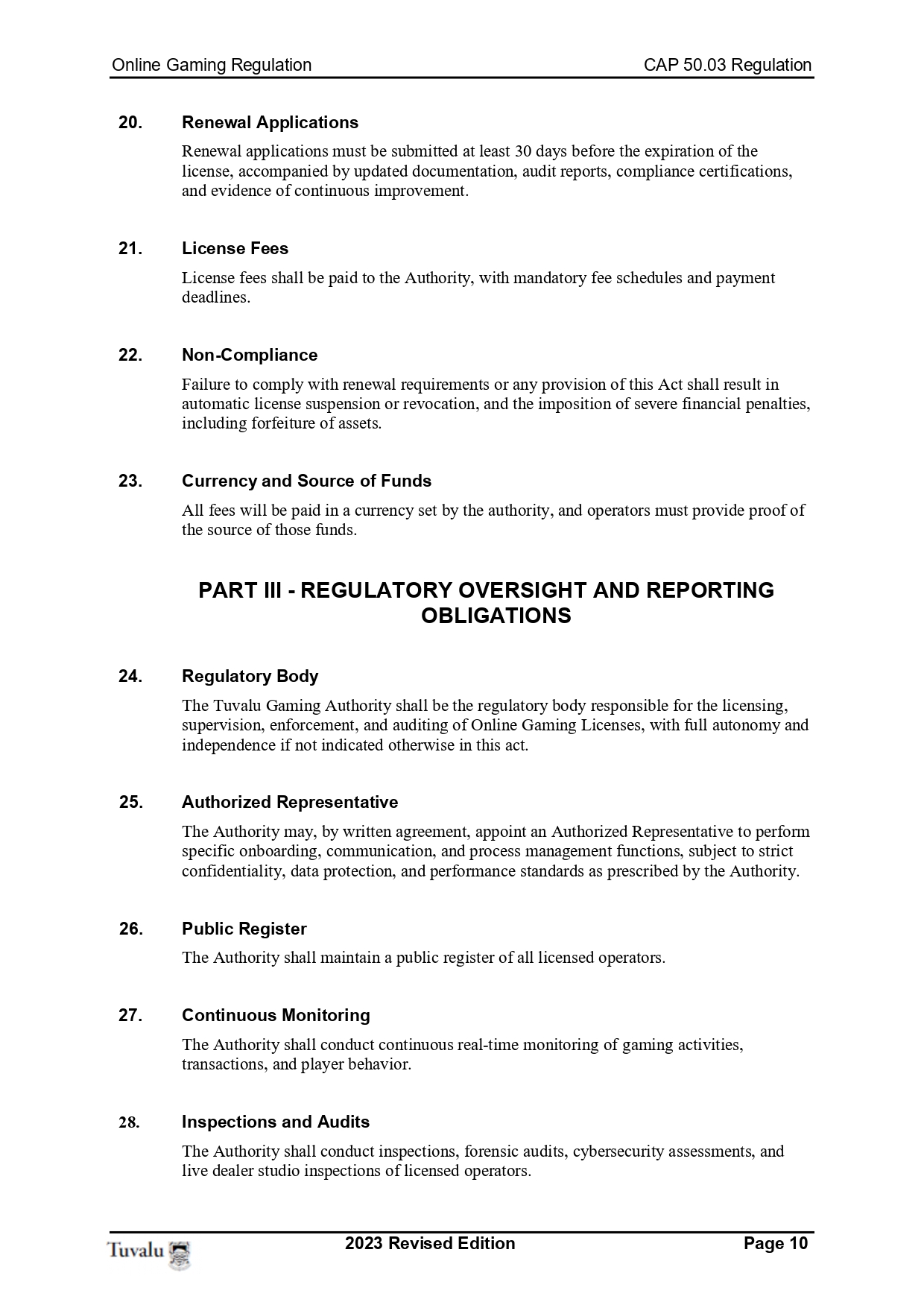
Renewal applications must be submitted at least 30 days before the expiration of the license, accompanied by updated documentation, audit reports, compliance certifications, and evidence of continuous improvement.
License fees shall be paid to the Authority, with mandatory fee schedules and payment deadlines.
Failure to comply with renewal requirements or any provision of this Act shall result in automatic license suspension or revocation, and the imposition of severe financial penalties, including forfeiture of assets.
All fees will be paid in a currency set by the authority, and operators must provide proof of the source of those funds.
OBLIGATIONS
The Tuvalu Gaming Authority shall be the regulatory body responsible for the licensing, supervision, enforcement, and auditing of Online Gaming Licenses, with full autonomy and independence if not indicated otherwise in this act.
The Authority may, by written agreement, appoint an Authorized Representative to perform specific onboarding, communication, and process management functions, subject to strict confidentiality, data protection, and performance standards as prescribed by the Authority.
The Authority shall maintain a public register of all licensed operators.
The Authority shall conduct continuous real-time monitoring of gaming activities, transactions, and player behavior.
The Authority shall conduct inspections, forensic audits, cybersecurity assessments, and live dealer studio inspections of licensed operators.
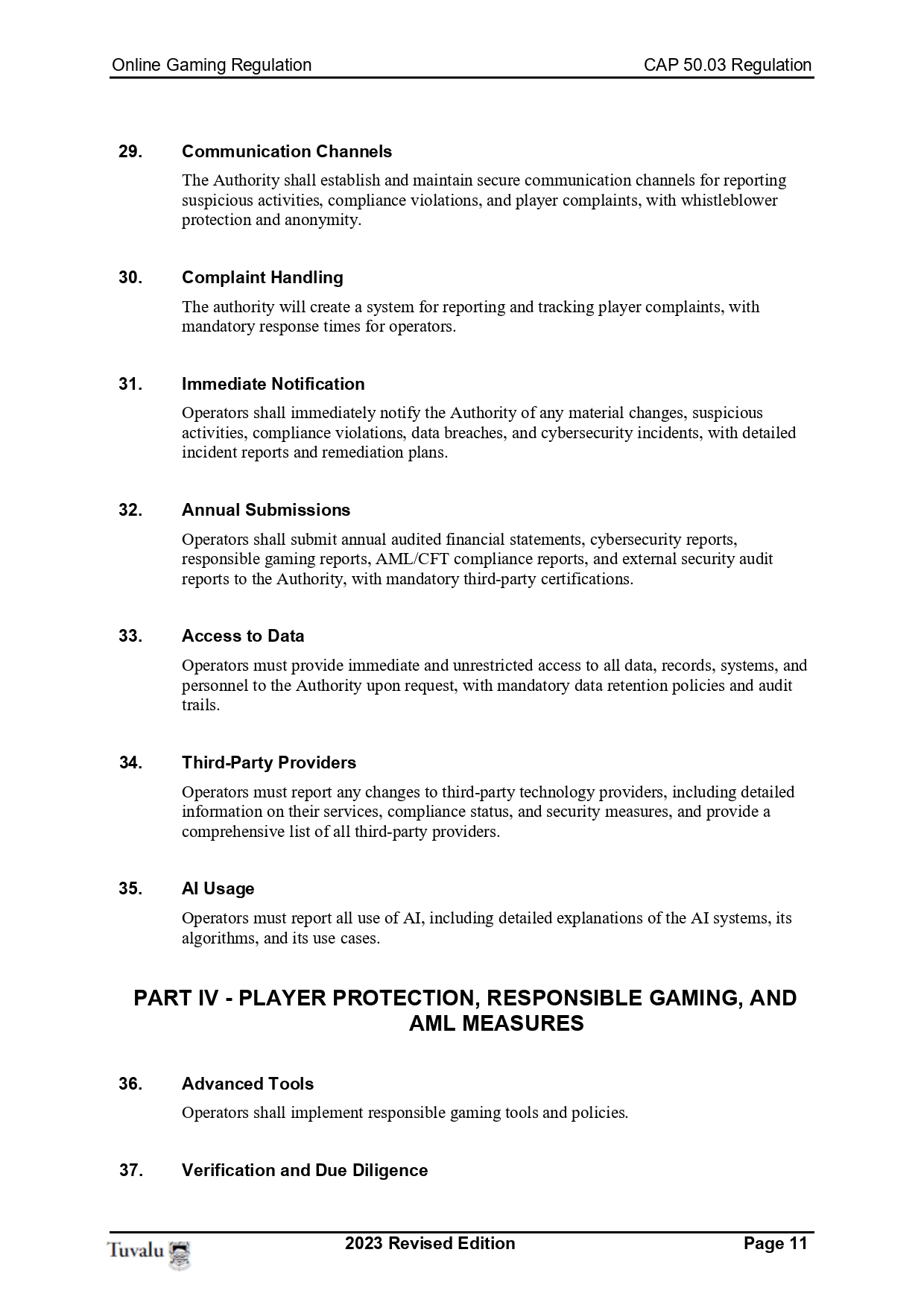
The Authority shall establish and maintain secure communication channels for reporting suspicious activities, compliance violations, and player complaints, with whistleblower protection and anonymity.
The authority will create a system for reporting and tracking player complaints, with mandatory response times for operators.
Operators shall immediately notify the Authority of any material changes, suspicious activities, compliance violations, data breaches, and cybersecurity incidents, with detailed incident reports and remediation plans.
Operators shall submit annual audited financial statements, cybersecurity reports, responsible gaming reports, AML/CFT compliance reports, and external security audit reports to the Authority, with mandatory third-party certifications.
Operators must provide immediate and unrestricted access to all data, records, systems, and personnel to the Authority upon request, with mandatory data retention policies and audit trails.
Operators must report any changes to third-party technology providers, including detailed information on their services, compliance status, and security measures, and provide a comprehensive list of all third-party providers.
Operators must report all use of AI, including detailed explanations of the AI systems, its algorithms, and its use cases.
AML MEASURES
Operators shall implement responsible gaming tools and policies.
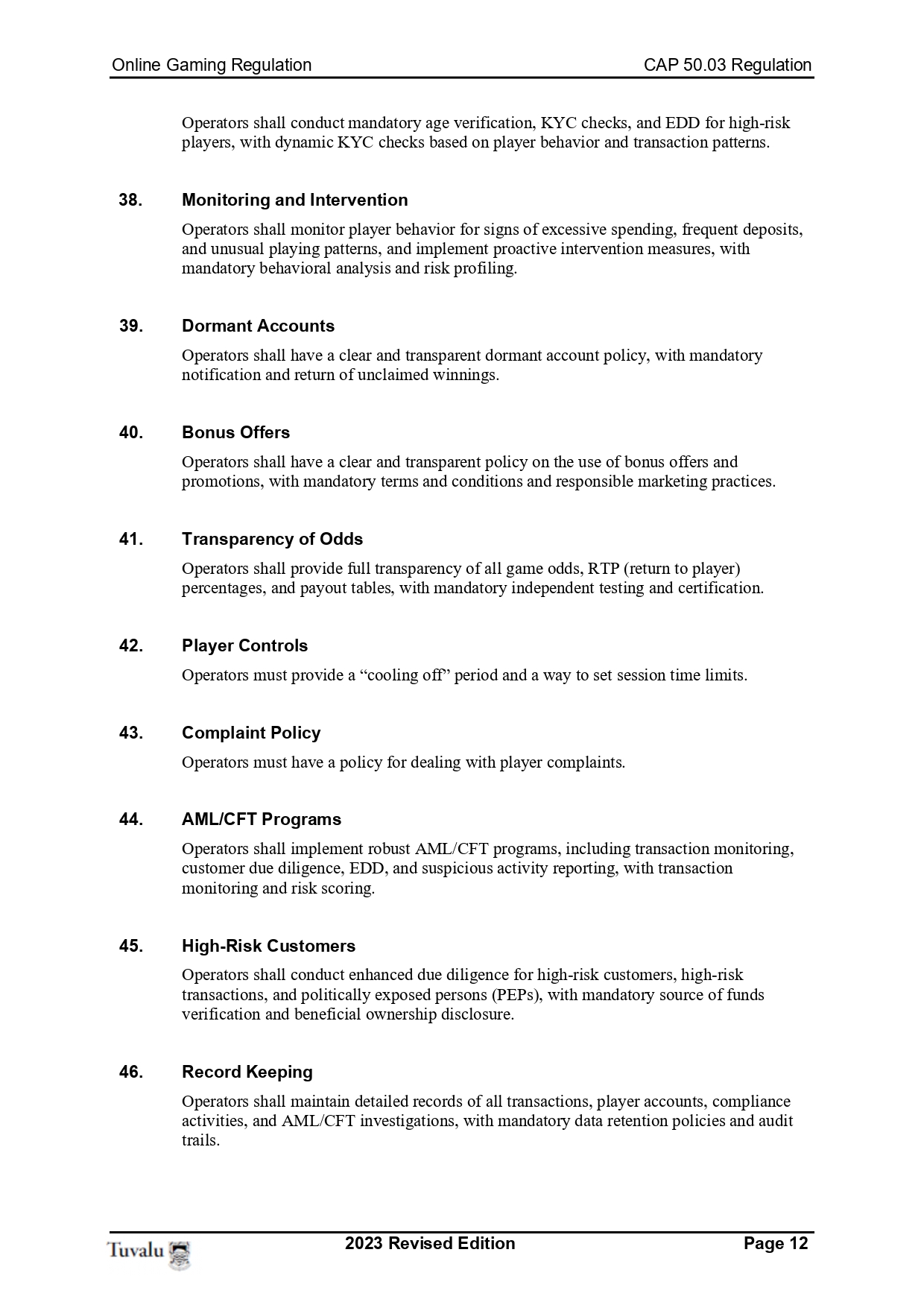
Operators shall conduct mandatory age verification, KYC checks, and EDD for high-risk players, with dynamic KYC checks based on player behavior and transaction patterns.
Operators shall monitor player behavior for signs of excessive spending, frequent deposits, and unusual playing patterns, and implement proactive intervention measures, with mandatory behavioral analysis and risk profiling.
Operators shall have a clear and transparent dormant account policy, with mandatory notification and return of unclaimed winnings.
Operators shall have a clear and transparent policy on the use of bonus offers and promotions, with mandatory terms and conditions and responsible marketing practices.
Operators shall provide full transparency of all game odds, RTP (return to player) percentages, and payout tables, with mandatory independent testing and certification.
Operators must provide a “cooling off” period and a way to set session time limits.
Operators must have a policy for dealing with player complaints.
Operators shall implement robust AML/CFT programs, including transaction monitoring, customer due diligence, EDD, and suspicious activity reporting, with transaction monitoring and risk scoring.
Operators shall conduct enhanced due diligence for high-risk customers, high-risk transactions, and politically exposed persons (PEPs), with mandatory source of funds verification and beneficial ownership disclosure.
Operators shall maintain detailed records of all transactions, player accounts, compliance activities, and AML/CFT investigations, with mandatory data retention policies and audit trails.
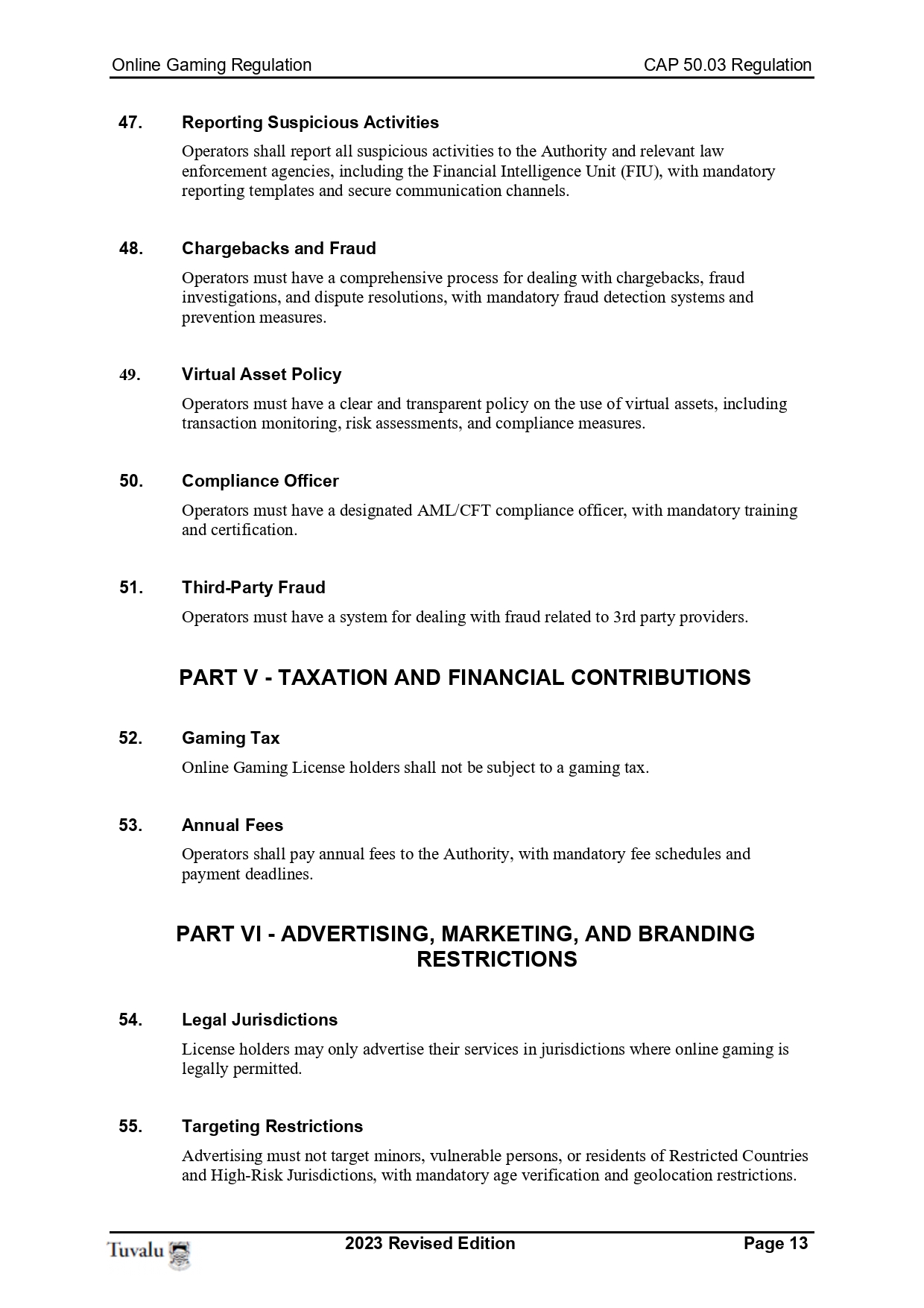
Operators shall report all suspicious activities to the Authority and relevant law enforcement agencies, including the Financial Intelligence Unit (FIU), with mandatory reporting templates and secure communication channels.
Operators must have a comprehensive process for dealing with chargebacks, fraud investigations, and dispute resolutions, with mandatory fraud detection systems and prevention measures.
Operators must have a clear and transparent policy on the use of virtual assets, including transaction monitoring, risk assessments, and compliance measures.
Operators must have a designated AML/CFT compliance officer, with mandatory training and certification.
Operators must have a system for dealing with fraud related to 3rd party providers.
Online Gaming License holders shall not be subject to a gaming tax.
Operators shall pay annual fees to the Authority, with mandatory fee schedules and payment deadlines.
RESTRICTIONS
License holders may only advertise their services in jurisdictions where online gaming is legally permitted.
Advertising must not target minors, vulnerable persons, or residents of Restricted Countries and High-Risk Jurisdictions, with mandatory age verification and geolocation restrictions.
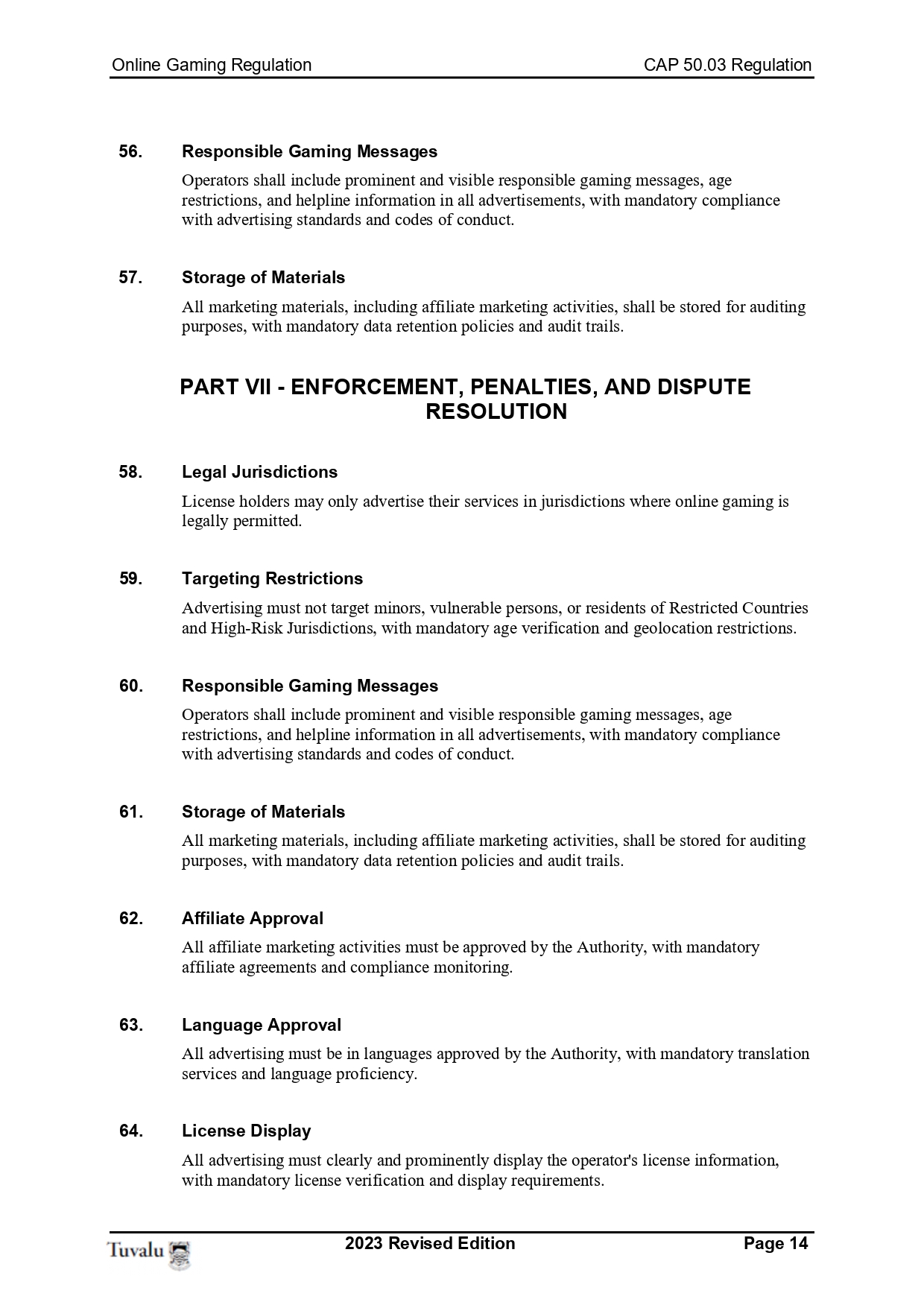
Operators shall include prominent and visible responsible gaming messages, age restrictions, and helpline information in all advertisements, with mandatory compliance with advertising standards and codes of conduct.
All marketing materials, including affiliate marketing activities, shall be stored for auditing purposes, with mandatory data retention policies and audit trails.
RESOLUTION
License holders may only advertise their services in jurisdictions where online gaming is legally permitted.
Advertising must not target minors, vulnerable persons, or residents of Restricted Countries and High-Risk Jurisdictions, with mandatory age verification and geolocation restrictions.
Operators shall include prominent and visible responsible gaming messages, age restrictions, and helpline information in all advertisements, with mandatory compliance with advertising standards and codes of conduct.
All marketing materials, including affiliate marketing activities, shall be stored for auditing purposes, with mandatory data retention policies and audit trails.
All affiliate marketing activities must be approved by the Authority, with mandatory affiliate agreements and compliance monitoring.
All advertising must be in languages approved by the Authority, with mandatory translation services and language proficiency.
All advertising must clearly and prominently display the operator’s license information, with mandatory license verification and display requirements.
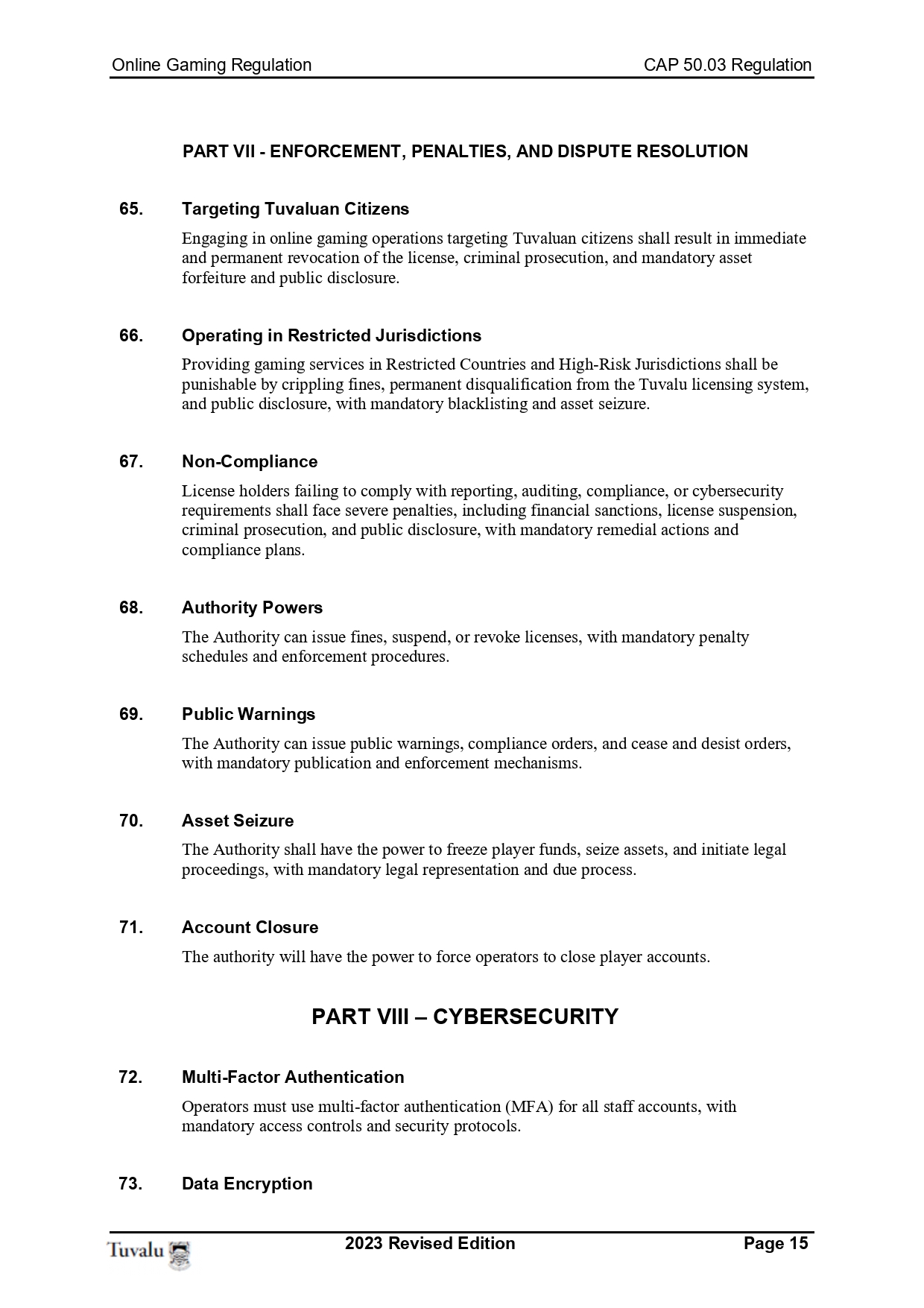
Engaging in online gaming operations targeting Tuvaluan citizens shall result in immediate and permanent revocation of the license, criminal prosecution, and mandatory asset forfeiture and public disclosure.
Providing gaming services in Restricted Countries and High-Risk Jurisdictions shall be punishable by crippling fines, permanent disqualification from the Tuvalu licensing system, and public disclosure, with mandatory blacklisting and asset seizure.
License holders failing to comply with reporting, auditing, compliance, or cybersecurity requirements shall face severe penalties, including financial sanctions, license suspension, criminal prosecution, and public disclosure, with mandatory remedial actions and compliance plans.
The Authority can issue fines, suspend, or revoke licenses, with mandatory penalty schedules and enforcement procedures.
The Authority can issue public warnings, compliance orders, and cease and desist orders, with mandatory publication and enforcement mechanisms.
The Authority shall have the power to freeze player funds, seize assets, and initiate legal proceedings, with mandatory legal representation and due process.
The authority will have the power to force operators to close player accounts.
Operators must use multi-factor authentication (MFA) for all staff accounts, with mandatory access controls and security protocols.
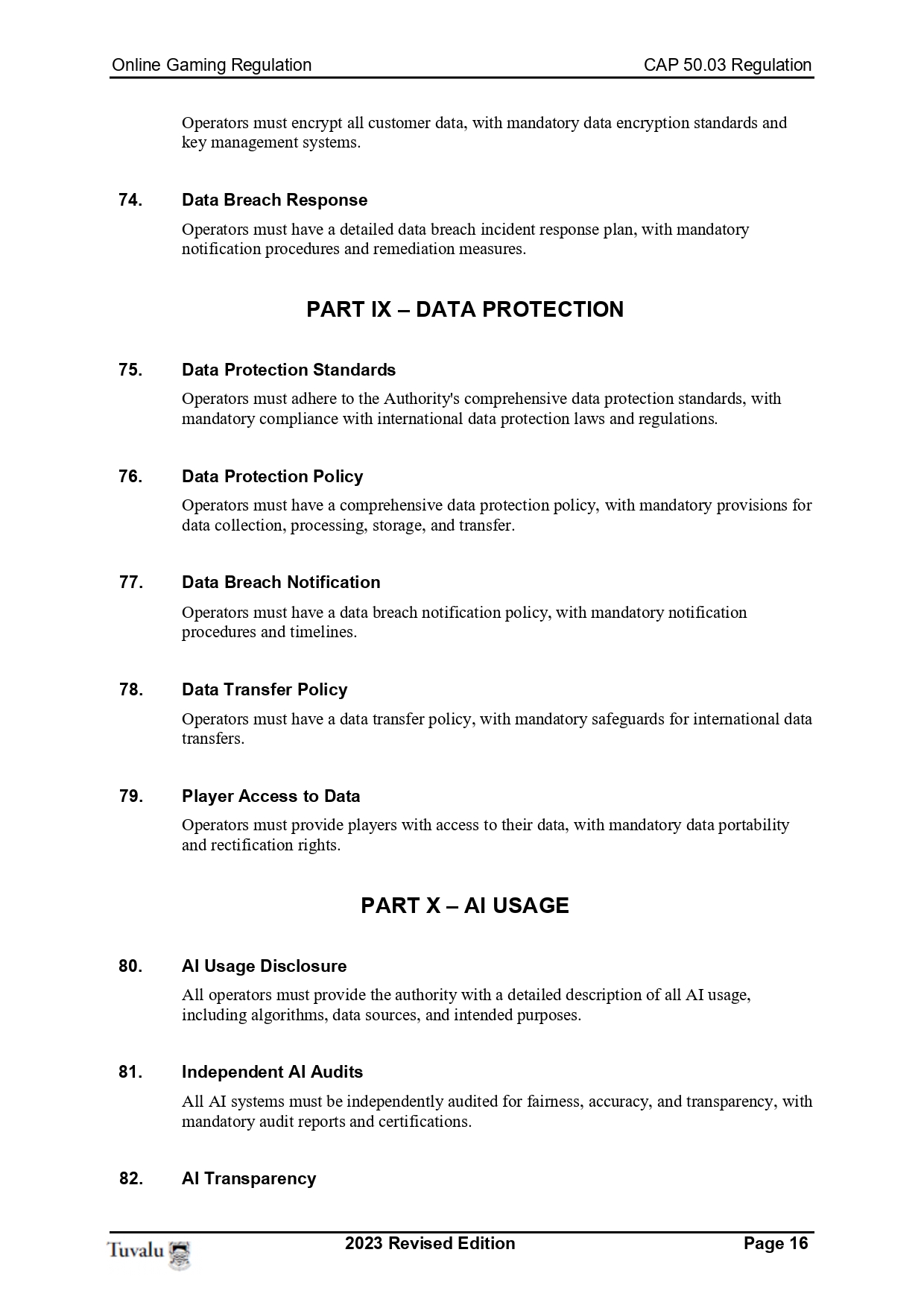
Operators must encrypt all customer data, with mandatory data encryption standards and key management systems.
Operators must have a detailed data breach incident response plan, with mandatory notification procedures and remediation measures.
Operators must adhere to the Authority’s comprehensive data protection standards, with mandatory compliance with international data protection laws and regulations.
Operators must have a comprehensive data protection policy, with mandatory provisions for data collection, processing, storage, and transfer.
Operators must have a data breach notification policy, with mandatory notification procedures and timelines.
Operators must have a data transfer policy, with mandatory safeguards for international data transfers.
Operators must provide players with access to their data, with mandatory data portability and rectification rights.
All operators must provide the authority with a detailed description of all AI usage, including algorithms, data sources, and intended purposes.
All AI systems must be independently audited for fairness, accuracy, and transparency, with mandatory audit reports and certifications.
All AI systems must be transparent and explainable, with mandatory documentation and user-friendly interfaces.
All AI systems must be regularly updated and monitored for performance, with mandatory version control and change management procedures.
Operators must have a clear and transparent policy for dealing with dormant accounts, with mandatory notification procedures and timeframes.
Operators must have a procedure for dealing with unclaimed winnings, with mandatory notification and return procedures.
After a specified period, unclaimed winnings must be transferred to the Authority, with mandatory reporting and documentation.
If any provision of this Act is found to be invalid or unenforceable by a court of competent jurisdiction, such invalidity shall not affect the remaining provisions, which shall continue in full force and effect.
This Act shall come into force on the date of its publication in the Official Gazette of Tuvalu.
No licenses shall be deemed valid under this Act prior to its enactment.
The Tuvalu Gaming Authority shall commence accepting applications for online gaming licenses no later than sixty (60) days after the Act’s official publication.
The Authority shall develop and publish additional regulations necessary for implementing this Act within ninety (90) days of its enactments.